

A burst fade is a fade that curves in a half circle around the ear and sweeps into the neckline. It is a shape for the sides and back, not a full haircut. That is why it works with a mullet, a mohawk, curls, a crop or a buzz cut.
This guide explains how the cut works, who it suits and how to choose between a low, mid and high version. You will also get five styles to show your barber, a simple brief to avoid bad surprises, and a care plan to keep it sharp.
What is a burst fade?
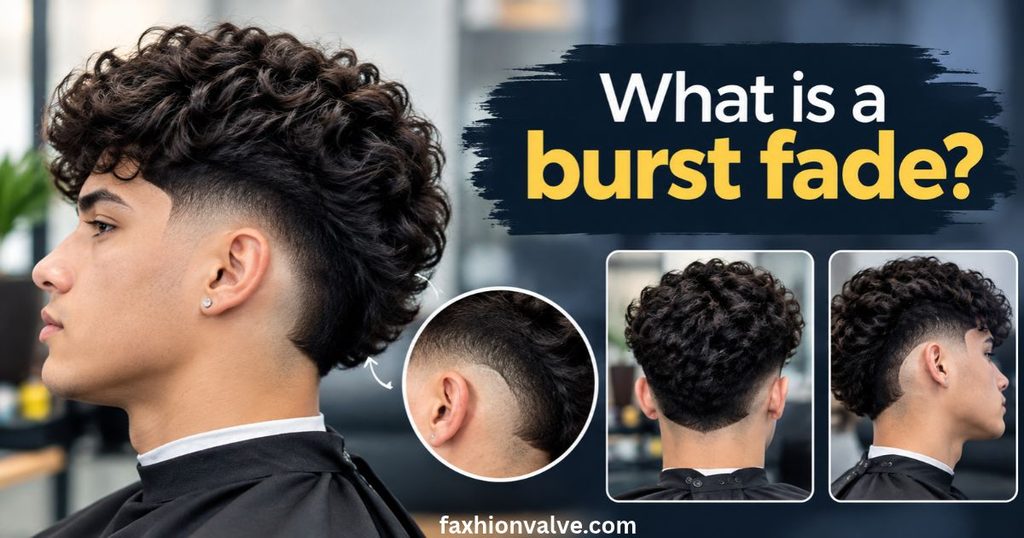
A burst fade is a fade haircut where the hair around the ear is cut in a rounded, semicircular shape. The length stays longer at the front and top, then “bursts” outward around the ear and drops down toward the nape. Barbers often describe it as a curve that frames the ear like a halo.
Quick answer: a burst fade is a curved fade around the ear that blends into the neckline, while the hair on top and at the front stays longer.
How does the burst shape work around the ear?
The barber starts the fade at the temple or just above the ear. Then they cut a smooth arc around the ear and carry it back to the nape. The shorter the clipper guard, the stronger the burst looks.
Here is the usual order of work:
- The barber marks the fade line at the height you choose (low, mid or high).
- Clippers on a longer guard rough out the arc around the ear.
- Shorter guards or a taper lever blend the arc down to the skin or a very short length.
- The neckline is finished either rounded, squared or tapered.
- The edges are tidied with trimmers or a razor.
What hair stays longer in a burst fade?
The hair on top, the front and often the back stays longer. Only the area around the ear and the lower sides is faded short.
- Top and fringe: left long for texture, curls or styling.
- Back: left long in a burst fade mullet, or tapered in a cleaner version.
- Sides above the burst: can be kept as a soft transition or cut tighter for contrast.
This contrast between a short ear area and longer hair elsewhere is what makes the cut easy to spot.
Who does a burst fade suit?

A burst fade suits most men who want a modern, defined shape without giving up length on top. It works for straight, wavy, curly and coily hair, and for most face shapes when the height is chosen well.
Which hair textures work with a burst fade?
- Straight hair: shows the curve cleanly. Works well with a crop or a side part.
- Wavy hair: the waves add movement above a sharp burst. Good for a textured mullet.
- Curly hair: the burst keeps curls tidy at the sides while the top stays full.
- Coily or Afro-textured hair: gives a crisp outline. A burst skin fade looks especially sharp on tight curls.
- Fine or thin hair: works if the top is kept short or lightly textured. A mid burst can create the look of more density.
How do head shape, density and lifestyle affect the choice?
Head shape, hair density and daily routine matter as much as hair type.
- Round face: a mid or high burst adds vertical lines and makes the face look longer.
- Long or oval face: a low burst keeps balance and avoids adding more height.
- Square face: a burst softens the jawline with its curved edge.
- Thin density or receding hairline: keep the top short or textured. Avoid very high bursts that expose thin areas.
- Thick density: you can go longer on top, but ask for thinning or texturizing so it does not look heavy.
- Office or formal dress code: a low burst with a soft blend is the safest choice.
- Active lifestyle or hot climate: a mid or high burst keeps the ears and neck cooler.
- Low-effort routine: pick a short top and a low burst so grow-out is gentle.
Low vs mid vs high burst fade: which should you choose?
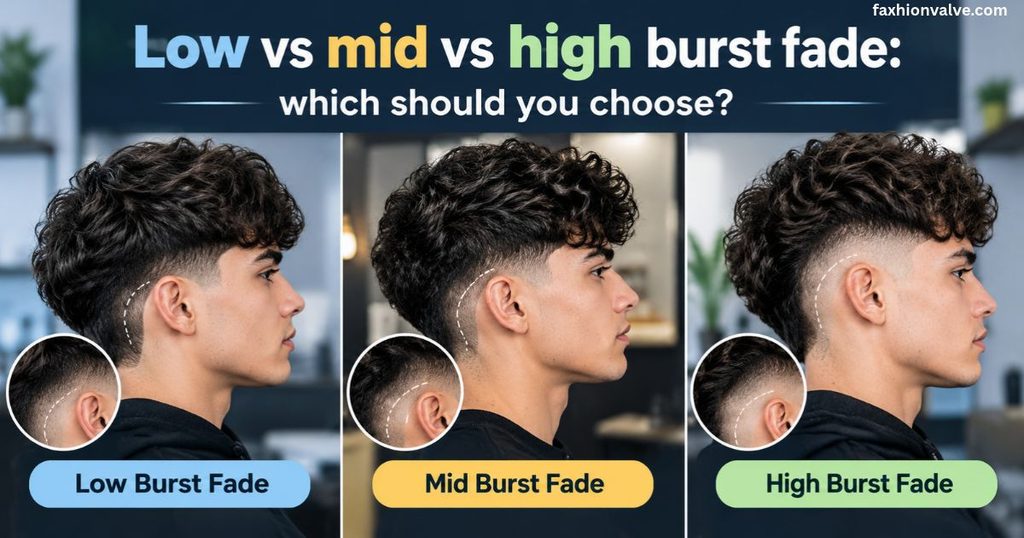
The height of the fade changes how bold the cut looks. Pick the height before you pick the style.
| Type | Where the fade starts | Look | Best for |
| Low burst fade | Just above the ear | Subtle, neat | Office, first-timers, longer tops |
| Mid burst fade | Around the temple | Balanced, modern | Most men, most hair types |
| High burst fade | Above the temple | Bold, high contrast | Short tops, mohawks, strong styles |
What is a low burst fade?
A low burst fade starts just above the ear and curves down toward the nape. It is the most conservative option. It keeps most of the side hair, so it looks tidy in a work setting. It is also the easiest to grow out.
What is a mid burst fade?
A mid burst fade begins around the temple. It shows the curve clearly without looking extreme. If you are unsure, this is the safest height to try. It suits nearly every texture and many face shapes.
What is a high burst fade?
A high burst fade starts above the temple, so a larger part of the sides is faded short. The contrast with the top is strong. It looks sharp with a mohawk, a faux hawk or a tall quiff. It also needs the most frequent upkeep.
Best burst fade styles to show your barber

Bring photos of the full look, not just the fade. These five styles cover most requests.
1. Burst fade mullet
The burst fade mullet is the most searched version. The sides are faded in a curve around the ears while the back stays long. The top can be layered, shaggy or sleek.
- Ask for a mid or low burst if you want a softer mullet.
- Ask for a high burst for a punk or modern edgy look.
- Keep the back length in proportion to the top so the shape flows.
2. Burst fade mohawk or faux hawk
A burst fade mohawk keeps a strip of longer hair along the center and fades the sides in a curve. A faux hawk is softer because the sides are not as tight.
- High burst gives the strongest mohawk contrast.
- Mid burst suits a faux hawk for daily wear.
3. Curly or coily burst fade
Curls and coils look defined when the sides are tight and the top is left full. The burst keeps the shape clean around the ear.
- Ask the barber to cut the top with the curl pattern in mind, not against it.
- A skin burst gives a crisp contrast on tight coils.
- Add a sharp line-up if you want a polished finish.
4. Short or textured-top burst fade
A textured crop, French crop or Ivy League cut pairs well with a burst. The top stays short and easy to style.
- Good for fine hair that cannot hold length.
- Needs regular barber visits because short cuts show growth fast.
5. Straight or wavy burst fade
Straight and wavy hair can be styled as a side part, slick back or messy fringe. The burst provides the clean frame.
- Use a medium hold product for shape.
- Ask for light texturizing so the top does not sit flat.
Burst fade vs drop fade, taper fade and skin fade

These terms are often mixed up. Some describe shape, and some describe how short the hair gets.
Burst fade vs drop fade
A drop fade curves down behind the ear and follows the skull. A burst fade curves around the ear itself and is rounder. If you want a line that sweeps low at the back, ask for a drop fade. If you want a half circle around the ear, ask for a burst.
Burst fade vs taper fade
A taper is a gradual shortening of hair, usually at the sideburns and neckline. A burst is a specific curved shape. A burst can include a taper, but a taper alone is not a burst. Tapers are subtler and more formal.
Burst fade vs skin fade
A skin fade goes down to bare skin. A burst fade describes the shape, not the length. You can have a burst skin fade, or a burst fade that stays at a short stubble length. If you do not want bare skin, say so clearly.
How to ask your barber for a burst fade
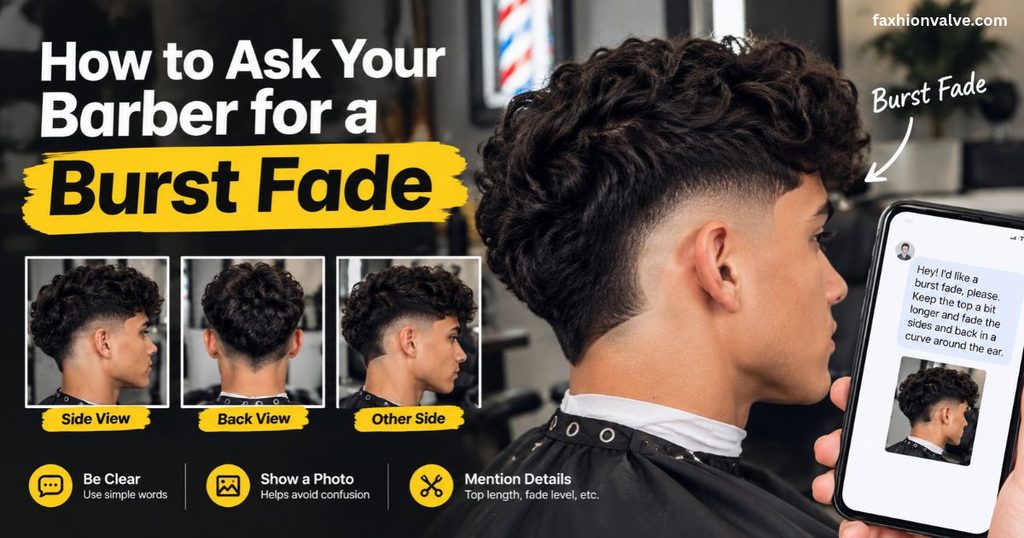
Barbers use slightly different words for the same cut. A clear brief saves time and prevents a haircut you did not want.
Use a five-point barber brief
Say these five things in order:
- Shape: “I want a burst fade around the ears.”
- Height: “Low,” “mid” or “high.”
- Length at the shortest point: “Skin,” “number 1” or “number 2 guard.”
- Top and back: “Keep the top long and the back long for a mullet” or “Taper the back.”
- Finish: “Rounded neckline,” “square neckline,” or “natural taper,” plus whether you want a beard blended in.
Example: “I would like a mid burst fade, skin at the shortest point, keep the top 4 inches, keep the back long, and a natural neckline.”
What should your reference photo show?
A good reference photo is the best tool you have.
- Pick a photo from the side and the back.
- Choose someone with similar hair texture and density.
- Show the exact height of the fade you want.
- Bring a second photo of what you do not want.
What are the most common miscommunications?
- “Burst fade” with no height: the barber guesses, and the result is too high or too low.
- Skin vs short: you wanted stubble but got bare skin.
- Burst vs drop: the curve ends up in the wrong place.
- Mullet length: “a little length at the back” means different things to different people.
- Neckline: a squared neckline looks very different from a rounded one.
How do you style a burst fade?

Style the top, and let the sides stay clean. Use a small amount of product on damp or dry hair, depending on texture.
Styling by hair texture and top style
- Straight hair, crop: use a matte clay or paste. Push the fringe forward.
- Straight hair, slick back: use a pomade on towel-dried hair and comb back.
- Wavy hair, mullet: use sea salt spray and let it air dry. Scrunch for more texture.
- Curly hair: apply a curl cream or leave-in conditioner on damp hair. Shape with your fingers and dry with a diffuser.
- Coily hair: moisturize first, then define with a twist or a soft brush.
- Mohawk or faux hawk: use a strong hold paste and shape the center strip upward.
Keep the sides free of heavy product. It makes the fade look dirty.
How long does a burst fade last, and how do you maintain it?

A burst fade looks its sharpest for about 1 to 2 weeks. Most men visit the barber every 2 to 4 weeks to keep the curve clean.
Touch-up timing and grow-out
- Skin or high burst: every 2 weeks.
- Mid burst: every 2 to 3 weeks.
- Low burst with longer sides: every 3 to 4 weeks.
- Grow-out: a low burst grows out softly in about 4 to 6 weeks. A skin burst shows a rough, patchy shape sooner.
If you want to grow it out, ask your barber for a clean-up around the neckline only.
Scalp and skin care for very close or skin bursts
Very short cuts expose the scalp, so a little care helps.
- Wash with a gentle shampoo and moisturize your scalp if it feels dry.
- Use sunscreen on exposed skin during the day.
- Avoid scratching after a fresh cut. It can cause irritation.
- If you get razor bumps, ask your barber to use clippers instead of a razor, and use a soothing aftershave balm.
Is a burst fade right for you?

It is a strong choice if you like clean lines and a modern look, and you are willing to visit a barber regularly.
Main benefits
- Works with many hair types and top styles.
- Gives a defined, polished outline.
- Offers a low, mid or high version for any dress code.
- Easy to style because the sides stay clean.
- Looks good on both short and long hair.
Trade-offs and edge cases
- Needs regular upkeep to keep the curve sharp.
- A poor cut shows quickly, so skill matters.
- High versions can look too bold in conservative workplaces.
- Very thin hair or a receding hairline may need a lower height.
- Sensitive scalps can react to very close cuts.
What are the best alternatives to a burst fade?

If the burst is not quite right, these options give a similar feel:
- Drop fade: a sweeping curve behind the ear.
- Taper fade: a subtle, classic finish.
- Temple fade: short at the temples with a rounded edge.
- Low skin fade: a clean and simple option.
- Undercut: a sharp disconnection without a gradual blend.
Frequently Asked Questions
What is a burst fade haircut?
It is a fade that curves in a half circle around the ear and blends into the neckline. The top and back can stay long.
Is a burst fade the same as a mullet?
No. The burst fade is the side technique, and the mullet is the full hairstyle. They are often combined.
What is the difference between a burst fade and a drop fade?
A burst fade curves around the ear in a round shape. A drop fade sweeps lower behind the ear.
Which burst fade height should I choose?
Choose low for a subtle look, mid for balance, and high for bold contrast. Mid is the safest starting point.
Does a burst fade work on curly or Afro-textured hair?
Yes. It keeps the sides sharp while the curls or coils stay full on top.
The bottom line
The burst fade is a curved fade around the ear that pairs with many hairstyles. Choose the height first, bring clear photos, and use a simple five-point brief so your barber knows exactly what you want. Keep up with regular trims, style the top lightly, and look after your scalp if you go very short.

Theo Grant is a hairstyle writer and content creator at Faxhion Valve, sharing practical insights on haircuts, styling ideas, and evolving hair trends. His approach focuses on clear research, useful guidance, and accessible information, helping readers explore hairstyles, understand styling options, and discover inspiration for their personal look.